Journey
thresholds
Station Clock
The iron hands refuse to hurry.
A whistle threads the air—
not command, but reminder
that every departure
is also a mock-up of return.
Tracks
Parallel lines persuade us
that direction is destiny,
yet the gravel between them
is littered with weeds
that never bought a ticket.
Compartments
Faces blur in the glass,
each reflection a stranger
carrying the same suitcase of silence.
We sit across from ourselves,
pretending the journey is elsewhere.
Terminus
The platform empties,
but the rails keep singing
long after the train has gone.
What remains is not arrival,
but the weight of having moved.
.


Author's Reflection on Static & Starfire: Poems from the Edge of Being
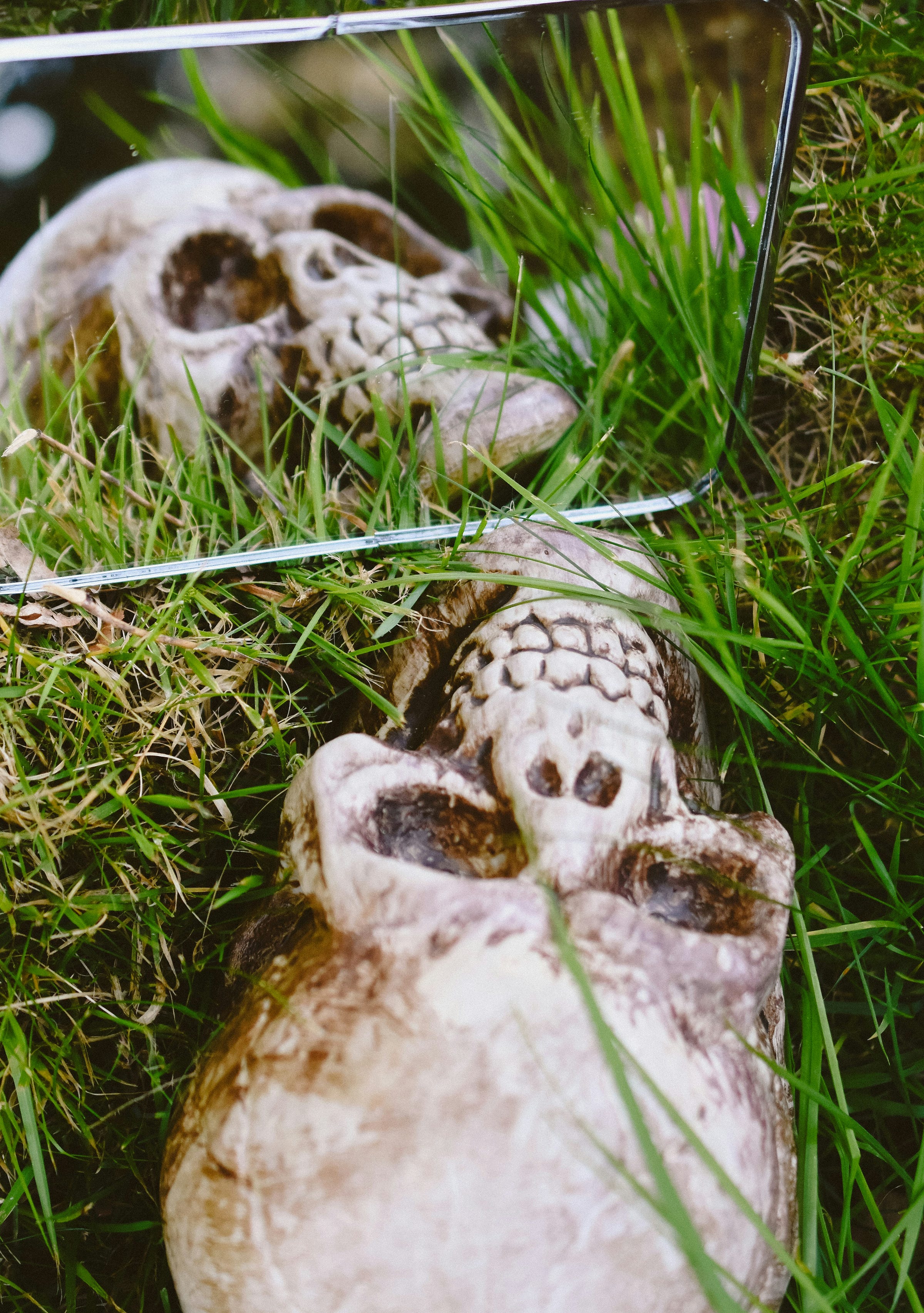
A skull reflected in tangled grass — a fleeting moment bridging endings and beginnings. Photo by Nik on Unsplash
Author’s Reflection
In gathering these eleven poems into “Static & Starfire,” I’ve traced the contours of my own unravelling and the faint frequencies that sometimes pierce through the static. This collection exists as a witness — neither monument nor memorial, but rather a constellation of moments suspended at the precipice.
I write from the threshold, that liminal space where certainty dissolves and possibility flickers. These poems do not chart a linear path from darkness to light — such narratives feel too neat, too certain for the territories I’ve traversed. Instead, they map the jagged geographies of a consciousness fragmented by systems of indifference, by the weight of documentation that somehow never suffices, by the gnawing certainty that some doors have permanently closed.
Yet even in mapping these shadowlands, I found myself drawn to the contrapuntal — the simultaneous existence of surrender and persistence, the quantum state where multiple truths coexist without collapsing into singular certainty. Like Schrödinger’s theoretical cat, these poems exist in superposition, containing both the voice that whispers “let go” and the one that murmurs “hold on,” neither drowning out the other.
The ink I’ve spilled here serves as both chronicle and compass. I cannot say where it leads. Some maps outline territories we need not visit; some bridges span chasms we might choose not to cross. What matters, perhaps, is the act of cartography itself — the naming of landmarks in an unmapped wilderness, the marking of paths both taken and untaken.
I offer these words not as a resolution but as an echo, not as an answer but as a question. They belong now to the reader, to interpret through the lens of their own luminous darkness, their own static and starfire.
In the crucible of these pages, I remain — like the poems themselves — suspended between multiple endings, authoring and reauthoring the self anew with each turning of the page.
— David Wakeham
10. Thresholds - Two voices one crossing
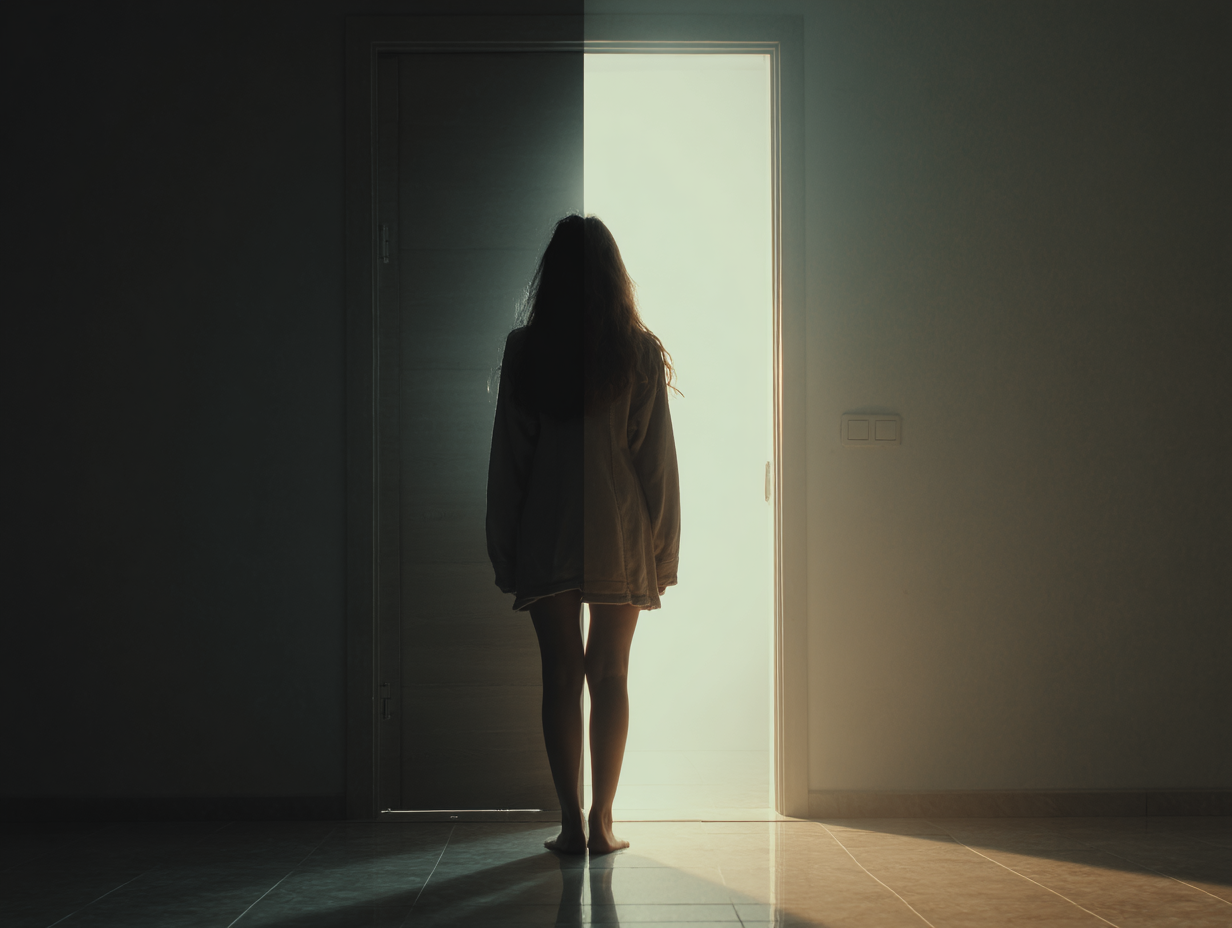
Standing at the threshold: two voices, one crossing — which will you hear first? Placeholder image by Midjourney v7.
Thresholds - Two voices one crossing
Voice of Surrender
The night presses in, heavy as regret,
Shadows coil, whispering, “Let go.”
I count the names I cannot save,
Each memory a stone in my pocket.
My beasts curl, sensing the end,
I leave instructions, trembling,
for a world that will not remember.
The streets wait, cold and unyielding,
I have no more shelter to give.
I write my name as a closing,
My ink a river running dry.
I slip into hush, a final release,
A whisper lost in the dark.
Voice of Resolve
The night presses in, but I strike a match,
Shadows coil, whispering, “Hold on.”
I count the names I carry forward,
Each memory a lantern in my hand.
My beasts curl, waiting for dawn,
I leave instructions, trembling,
for a world that may yet remember.
The streets wait, cold but unbroken,
I have more shelter to find.
I write my name as a beginning,
My ink a river rising strong.
I step into hush, a gathering breath,
A whisper forging the dawn.
Navigating the Grey: The Enduring Oath
"Primum non nocere," a principle profound,
Not rigid law, but wisdom found.
In healing's halls, where choices weigh,
It guides the hand, but doesn't sway.
"ὀφελέειν ἢ μὴ βλάπτειν," a balanced plea,
"To benefit, or harm not," complexity's key.
Not black and white, but shades between,
Where modern medicine's challenges are seen.
The caduceus gleams, oft misunderstood,
While Asclepius' staff stands where healing stood.
Symbols twisted, meanings blurred,
Yet ethical practice remains undeterred.
In sterile rooms where decisions loom,
Doctors and patients dispel the gloom.
They weigh the risks, consider gain,
In partnership, to ease the pain.
Some peddle falsehoods, sweet and bright,
While truth seeks haven in the night.
But evidence-based practice stands tall,
Against deception's siren call.
"Primum nil nocere," evolving still,
Not perfection, but good faith's will.
To strive for best, while harm to shun,
In healing's never-ending run.
In research labs and by bedsides true,
Ethical minds seek what to do.
Through trials tested, with knowledge bright,
They pierce the veil of health's long night.
"To benefit, or harm not," the true decree,
A beacon burning, for all to see.
Not simple maxim, but complex art,
Where science meets the human heart.
With shared trust, respect held high,
Patient and healer together try
To chart a course through health's dark sea,
With ethics as their guiding key.
Beyond the Lie: True Healing’s Path
Πρῶτον μὴ βλάπτειν, a principle misunderstood,
Not black and white, but shades of good.
Where healing's art meets science's light,
And ethical minds must choose what's right.
The caduceus gleams, a symbol misconstrued,
Where commerce and care are often viewed.
But Asclepius' staff, with single snake entwined,
Represents true healing, carefully refined.
In modern halls where choices weigh,
Doctors and patients find their way.
Through risks and benefits, they navigate,
Shared understanding they cultivate.
Some peddle cures with hollow claims,
Exploiting fears for selfish aims.
But true healers, with knowledge sound,
On evidence their practice ground.
"Primum nil nocere," a guide, not chain,
Encouraging thought in health's domain.
Balance sought 'twixt act and pause,
For healing's not without its flaws.
In research labs and by bedsides too,
Ethical minds seek what is true.
Through trials tested, their wisdom grows,
A beacon bright as knowledge flows.
ὀφελέειν ἢ μὴ βλάπτειν, the call remains,
For those who heal, not those who feign.
In partnership with those they treat,
They strive to make care more complete.