poemist
Croesus in the Comment Box
Croesus in the Comment Box
(a companion to “Poems for Money…”)
Croesus, old coin‑king,
you sit in my comment box
polishing your metaphors in gold leaf,
telling me the platform fee is “just the cost of doing art.”
But I’ve seen the gates,
how they swing only for those
with a credit card in the lock.
I’ve heard the hallow of poems
that never make it past the paywall,
their syllables still warm in the mouths
of poets who can’t afford
to spit them into the feed.
You say, “What’s a few coins for immortality?”
I say, “What’s immortality to the unheard?”
In Lagos, in La Paz, in Lahore,
there are verses that could split the sky,
but the sky here takes payment in advance.
Croesus, you measure worth in minted weight;
I measure it in the tremor of a line
that makes a stranger’s chest ache.
Your treasury is full,
but my currency is breath —
and breath should not be billed.
Still, I post what I can,
slipping lines through the cracks
between your gold‑plated rules,
hoping one will land in a reader’s hands
like contraband joy.
And if you ask me again
why I won’t pay to be heard,
I’ll tell you this:
because the richest poem I know
was written in the dust,
read aloud to the wind,
and carried farther than your coins could ever reach.


in the swelling tide
"—in the quiet tide"
an unread poem
is unwritten poetry —
ink still dreaming in the vein,
a slow current beneath the skin
where no light has yet entered.
Pages breathe in the dark,
their margins uncreased
by any gaze,
their fibres holding the faint salt
of the tree’s first rain.
They live in the quiet tide
before the pen descends,
in the pause
between heartbeat and word,
where silence folds itself
into a listening shape.
In the shadow‑scent of paper
waiting
to be touched by thought,
you can almost hear
the hush of unwoken syllables
turning in their sleep.
Some drift closer
to the shore of speech,
their edges foaming with consonants,
then slip back
into the mind’s undertow —
a retreat as deliberate as arrival.
Perfect in their unspilled form,
they are a library of ghosts,
each spine uncracked,
each title a tide‑mark
on the inner coast.
And we,
keepers of this unbroken harbour,
carry them —
the weight of what has not yet been said,
the shimmer of what may never be —
bound in the quiet tide
that moves through us,
and returns,
and moves again.
.
The Wizard of Sand
I am not the benevolent Oz, great or otherwise —
no levers behind velvet, no emerald gates to dazzle the credulous —
only the stubborn machinery of my own making,
a few cogs greased with irony,
a crank that squeaks in the key of
don’t take this too seriously,
until the hum you mistake for a hymn
becomes the wind over a toppled statue in the sand.
Once, its face wore the smirk of a ruler certain he’d outlast the sun.
The words at its base still shout about greatness —
but there’s nothing left to rule but air and grit.
Your fawn‑eyed devotion is touching,
in the way a moth’s devotion to a porch light is touching,
and just as doomed.
Look on my works, ye Mighty — and bring a broom;
the dust is winning,
and the curtain you thought was closing
was only the desert swallowing the stage.
.
in the quiet tide
The Silence Between Lines
Unread poems
are unwritten poetry —
ink still dreaming in the vein,
pages breathing in the dark,
their margins uncreased
by any gaze.
They live in the quiet tide
before the pen descends,
in the pause
between heartbeat and word,
in the shadow‑scent of paper
waiting
to be touched by thought.
Some drift closer
to the shore of speech,
then slip back
into the mind’s undertow —
perfect in their unspilled form,
a library of ghosts
bound in the quiet tide
we carry.
.
misunderstood butterflies
the scrolls stare back like a shopfront window
where the mannequins wear my metaphors,
price tags swinging from their wrists.
You didn't shake their wrists,
but I saw it nonetheless—
tags fluttering away like pale,
misunderstood butterflies.
.
the archivist
The Archivist
Breath—
caught in the rafters’ dim lattice,
a leaf turns,
seasonless.
Dust,
a pale script
unfolding in the hollow of a hand.
Spines incline—
mute elders—
their gilt a slow
constellation.
No pen,
yet the air
breaks into lines,
each pause
a door
unlatched in silence.
Volume shut—
not ending,
but the echo
of a word
never spoken.
.
the archive wing
The Archive Wing
The door is oak,
its brass plate worn to a soft blur
by decades of palms.
Inside, the air holds
the dry perfume of paper and cloth,
a faint trace of polish on the banisters.
Shelves rise like terraces,
each step a year,
each row a street in the city’s past.
Ledgers with spines like brick courses
stand shoulder to shoulder,
their titles lettered in gilt
that catches the afternoon light.
A clerk in a grey waistcoat
moves along the gallery,
his pencil ticking in the margin
of a bound minute book.
Below, a student copies
a map of the tramlines
into a ruled notebook —
ink pooling in the loops of her script.
Here, the city keeps
its own autobiography:
births and bankruptcies,
contracts and commemorations,
all pressed flat between covers.
The silence is not absence,
but the pause between sentences
in a paragraph still being written.
.
The Saga in the Hall
The Saga in the Hall
The clock in the concourse
keeps its brass face polished,
though the trains run late.
Below it, the tiled floor
is a saga of heelstrikes and scuffmarks —
polished brogues, steel‑capped boots,
heels that click like typebars.
Through the high windows,
light falls in measured squares,
as if the city itself
were an architect’s drawing.
You can almost hear
the draughtsman’s pencil
in the click and crackle of the switchboard,
the hiss and spit of the espresso machine
in the corner kiosk —
each sound another line
in the day’s unfolding chapter.
Here, commerce is not a shout
but a handshake;
industry not a furnace roar
but the steady bite of gears
in the lift shaft.
The air carries the tang of paper,
ink, and rain
that beads on overcoats —
all of it pressed into the floor’s
long memory of arrivals and departures.
We are all shareholders here —
clerks and porters,
managers and machinists —
each with a stake in the day’s
quiet transactions.
The building holds us
like a sentence holds its clauses,
each brick a word,
each scuffmark a comma,
in the city’s long,
unbroken paragraph.
.
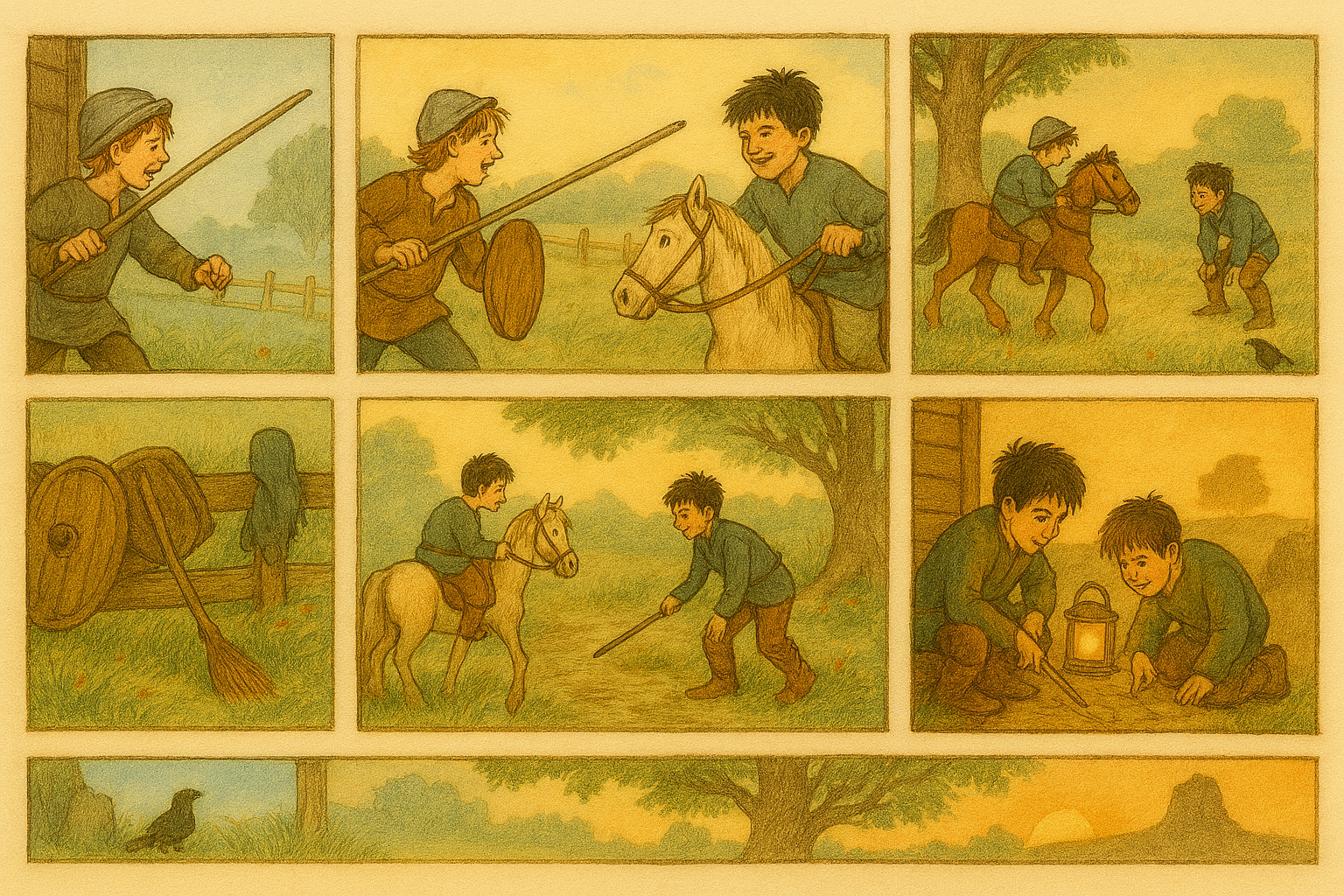
homestead knights
Homestead Knights
(for Arthur and Kay, before the Stone)
In the paddock’s dawn‑mist,
we joust with broom‑handles,
helmets dented from
last winter’s wood‑pile war.
Kay swears his steed
is faster than mine —
though both are milk‑cart ponies
with hay in their manes
and the patience of saints.
Our shields are feed‑bin lids,
our gauntlets, mother’s old mittens;
we ride the fence‑line
as if it were the edge of the realm.
Between chores,
we patrol the creek ford,
banish thistles from the path,
and guard the henhouse
from foxes real and imagined.
At night,
we sit on the porch steps,
boots steaming in the cool,
and plan the next day’s campaign —
whether to conquer the far paddock
or finally dare the dark of the shed.
Somewhere beyond the hill,
a stone waits in its clearing,
but for now
the kingdom is here:
two knights of the homestead,
sworn to the crown
of the rising sun.
.
.
.