kesnerfrederickpoem
the archivist
The Archivist
Breath—
caught in the rafters’ dim lattice,
a leaf turns,
seasonless.
Dust,
a pale script
unfolding in the hollow of a hand.
Spines incline—
mute elders—
their gilt a slow
constellation.
No pen,
yet the air
breaks into lines,
each pause
a door
unlatched in silence.
Volume shut—
not ending,
but the echo
of a word
never spoken.
.


the archive wing
The Archive Wing
The door is oak,
its brass plate worn to a soft blur
by decades of palms.
Inside, the air holds
the dry perfume of paper and cloth,
a faint trace of polish on the banisters.
Shelves rise like terraces,
each step a year,
each row a street in the city’s past.
Ledgers with spines like brick courses
stand shoulder to shoulder,
their titles lettered in gilt
that catches the afternoon light.
A clerk in a grey waistcoat
moves along the gallery,
his pencil ticking in the margin
of a bound minute book.
Below, a student copies
a map of the tramlines
into a ruled notebook —
ink pooling in the loops of her script.
Here, the city keeps
its own autobiography:
births and bankruptcies,
contracts and commemorations,
all pressed flat between covers.
The silence is not absence,
but the pause between sentences
in a paragraph still being written.
.
The Saga in the Hall
The Saga in the Hall
The clock in the concourse
keeps its brass face polished,
though the trains run late.
Below it, the tiled floor
is a saga of heelstrikes and scuffmarks —
polished brogues, steel‑capped boots,
heels that click like typebars.
Through the high windows,
light falls in measured squares,
as if the city itself
were an architect’s drawing.
You can almost hear
the draughtsman’s pencil
in the click and crackle of the switchboard,
the hiss and spit of the espresso machine
in the corner kiosk —
each sound another line
in the day’s unfolding chapter.
Here, commerce is not a shout
but a handshake;
industry not a furnace roar
but the steady bite of gears
in the lift shaft.
The air carries the tang of paper,
ink, and rain
that beads on overcoats —
all of it pressed into the floor’s
long memory of arrivals and departures.
We are all shareholders here —
clerks and porters,
managers and machinists —
each with a stake in the day’s
quiet transactions.
The building holds us
like a sentence holds its clauses,
each brick a word,
each scuffmark a comma,
in the city’s long,
unbroken paragraph.
.
homestead knights
Homestead Knights
(for Arthur and Kay, before the Stone)
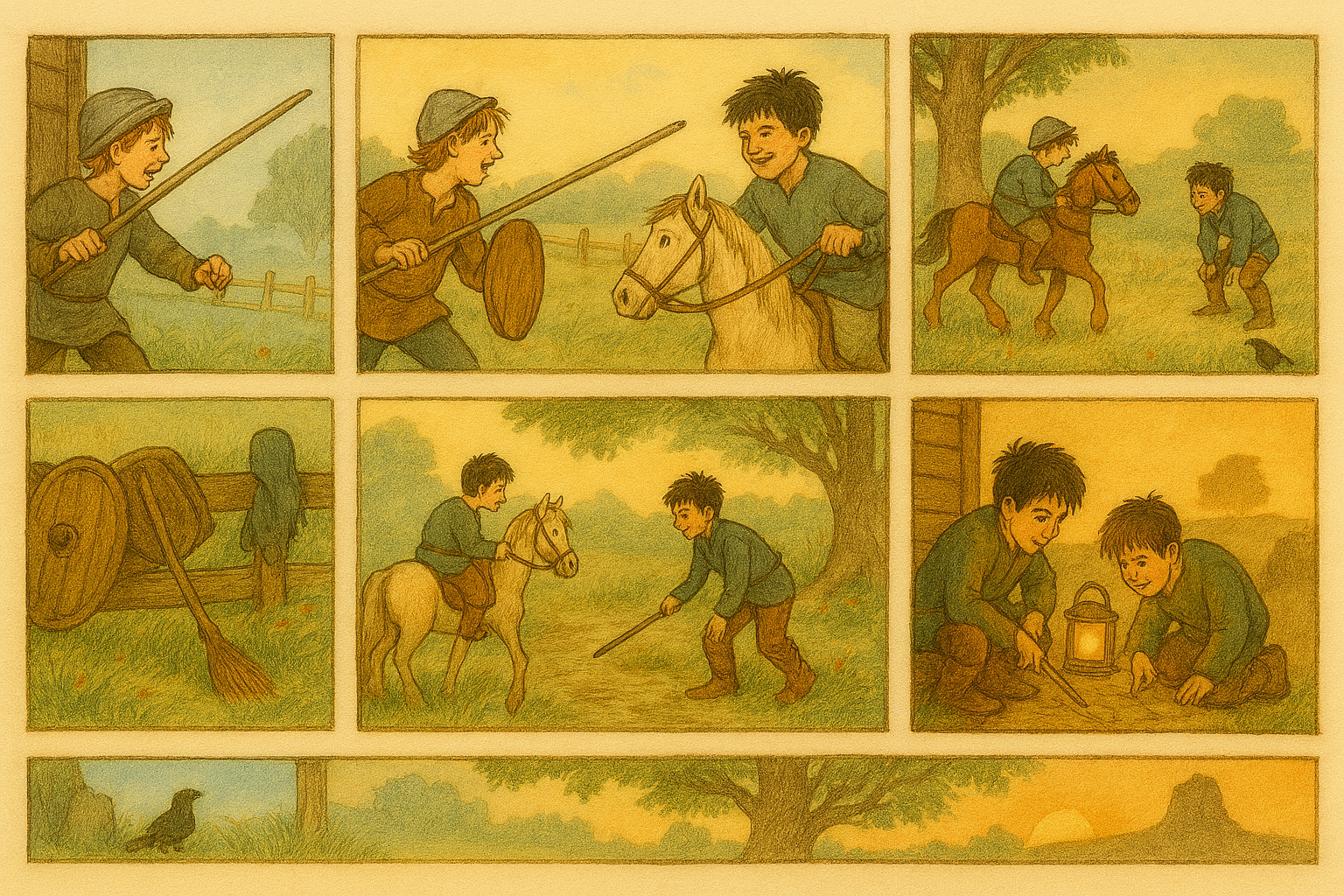
In the paddock’s dawn‑mist,
we joust with broom‑handles,
helmets dented from
last winter’s wood‑pile war.
Kay swears his steed
is faster than mine —
though both are milk‑cart ponies
with hay in their manes
and the patience of saints.
Our shields are feed‑bin lids,
our gauntlets, mother’s old mittens;
we ride the fence‑line
as if it were the edge of the realm.
Between chores,
we patrol the creek ford,
banish thistles from the path,
and guard the henhouse
from foxes real and imagined.
At night,
we sit on the porch steps,
boots steaming in the cool,
and plan the next day’s campaign —
whether to conquer the far paddock
or finally dare the dark of the shed.
Somewhere beyond the hill,
a stone waits in its clearing,
but for now
the kingdom is here:
two knights of the homestead,
sworn to the crown
of the rising sun.
.
.
.
paddock domain (short)
In the paddock’s breath,
two lances tilt toward laughter —
ponies patient as old kings,
crowns of sunlight
slipping
down our brows.
legend of a feather's loop
Legend of a Feather’s Loop
Follow the gold path to walk the day from mist to glint —
Feather at dawn, Crow at the fence, Fox in the thistle,
Lantern where the conclave leans close, Hill in the last light,
and the Glint that waits for the hand that knows the way back.
Follow the silver path to retrace the memory —
Glint to Hill, Lantern to Fox, Crow to Feather —
until the first breath of morning closes the circle.
the way back
Feather drifts in the paddock mist,
catches on a fence where the crow keeps watch,
slips past thistle and shadow‑fox,
rests by the lantern in the council’s glow —
and somewhere beyond the hill,
a glint waits for the hand that knows the way back.
life-arc
Life‑Arc Diptych
I. Townhouse Days — Looking Back
In the upper case,
a volume the colour of
late‑harvest light,
its spine breathing
salt and iron.
I keep it ajar —
not for dust,
but so the mapped water
can run beside
my own small channel,
each bend marked
in a hand I almost know.
Through the plaster,
a swell of brass‑warm air —
someone’s breath
caught in a long note,
turning the parlour
to water.
I did not rise,
only let the sound
find its own shelf
between the maps,
where it could lean
against a memory
I had not yet
admitted was mine.
Between the first assent
and the last,
a pressed leaf holds
streets I never walked;
in the hollow
where a page was long gone,
I’ve set a three‑part hinge:
motion, tether,
threshold.
It waits there,
not as ornament,
but as one more
voice in the palimpsest —
leaning into
the window I still
leave unlatched.
Hinge — Platform Light
Between the last stair
and the first step down,
I carry both airs —
brick‑warm and hay‑sweet —
in the same breath.
The train waits,
engine ticking like a clock
that belongs to neither house,
and I stand in its glow,
already partway gone,
already halfway home.
II. Homestead Nights — Looking Forward
The road out of the city
was a long exhale —
brick giving way to hedgerow,
hedgerow to open field.
By dusk, the air
tasted of cut grass and diesel,
and the porch light
was the only star
that didn’t blink.
In the kitchen,
boots left by the door
like commas in a sentence
I’d been writing all term.
Nights here were wide —
crickets stitching the dark,
the wind combing the wheat,
the barn’s slow breath
settling into the rafters.
Come morning,
the rooster’s call
would fold me back
into the farm’s grammar,
but for now
I lay between two lives —
one lit by streetlamps,
one by the moon on tin —
and felt the tracks
still pulsing
under my skin.
.
looking back
Looking Back
In the upper case,
a volume the colour of
late‑harvest light,
its spine breathing
salt and iron.
I keep it ajar —
not for dust,
but so the mapped water
can run beside
my own small channel,
each bend marked
in a hand I almost know.
Through the plaster,
a swell of brass‑warm air —
someone’s breath
caught in a long note,
turning the parlour
to water.
I did not rise,
only let the sound
find its own shelf
between the maps,
where it could lean
against a memory
I had not yet
admitted was mine.
Between the first assent
and the last,
a pressed leaf holds
streets I never walked;
in the hollow
where a page was long gone,
I’ve set a three‑part hinge:
motion, tether,
threshold.
It waits there,
not as ornament,
but as one more
voice in the palimpsest —
leaning into
the window I still
leave unlatched.
.