kesnerfrederick
forward together
forward together
The bus doors breathe open—
a tide of shoes,
plastic bags whispering
against one another.
Someone mouths a tune to airpods.
It is enough,
for now,
to be carried forward together.
.


what was almost said
I begin with ~~certainty~~
no—only the tremor of a line,
a draft that refuses to settle.
The page offers ~~silence~~
but I write into its margins,
naming what cannot be named.
You read the ~~crossed-out~~ words
as if they were confessions,
but they are only scaffolds,
a way of showing the wound
without pointing to it.
I keep ~~erasing~~,
not to hide,
but to let you see
the ghost of what was almost said.
And when you arrive at the end,
you will find nothing resolved—
only the trace of our dialogue,
a ledger of ~~mistakes~~
that were never mistakes at all.
wrapped in ashphalt and irony
Wrapped in Asphalt and Irony
Not with a halo,
but with a steering column—
the philosopher of the absurd
meets his curtain call
in a ditch,
the Vega’s chrome twisted
like punctuation gone feral.
And yet—
he strides the void like an anime hero,
cape stitched from moth manifestos,
eyes blazing not with “Believe in yourself!”
but with the harsher creed:
“One must imagine Sisyphus happy.”
The crowd roars,
not in faith,
but in disbelief—
that the man who taught us
to laugh at the void
was himself
laughed off the road
by contingency.
Tree or tarmac,
what’s the difference?
The absurd doesn’t care
for scenery.
It only cares
that the script ends
mid-sentence,
the ink still wet,
the ticket still unused.
So here’s the irony,
sharp enough to cut:
Camus, who crowned absurdity,
was crowned by it—
not with laurel,
but with shattered glass,
a coronation of accident.
Nevertheless—
and this is the only word
worth keeping—
his voice still declaims
through the wreckage:
not a sermon,
not a consolation,
but a dare:
to wear absurdity
as the only crown
that fits.
.
no exit, no arrival
"No Exit, No Arrival"
A Beckettian fragment in two voices
Characters:
-
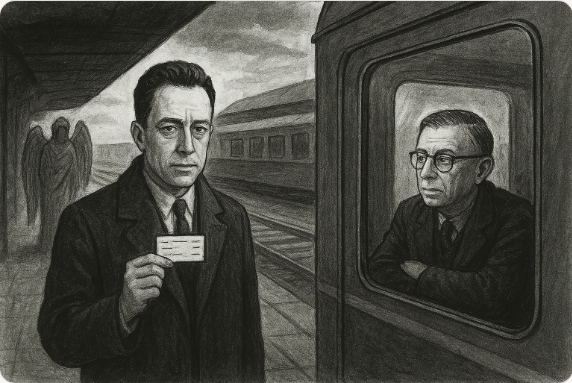
Camus (on the platform, holding a ticket)
-
Sartre (inside a carriage, visible through the window)
-
Silence (offstage, but present)
(Dim light. A platform. A train stands still, doors closed.
Camus paces, ticket in hand. Sartre sits in the carriage,
staring outward. Neither moves closer.)
Camus: The train has left.
(looks at ticket)
But it has not moved.
Sartre: (through the window)
Hell is other people.
Especially when they sit too close.
Camus: I am alone.
That is worse.
Or better.
Or neither.
Sartre: There is no exit.
Only compartments.
And coughs.
Camus: I missed my ride.
Perhaps that was the ride.
Perhaps this is the punishment.
Sartre: Punishment?
No.
Merely company.
Which is worse.
(Silence enters. Both men look at it.
Silence says nothing. They nod.)
Camus: One must imagine Sisyphus happy.
Sartre: One must imagine the carriage full.
Forever.
(The train whistle blows. Nothing moves.
Lights dim. Curtain does not fall.)
.
.
.
parable of two wrecks
Parable of Two Wrecks
Dean’s collision left a boy in a Ford,
haunted by silence,
living decades with the weight of a single instant,
his name footnoted, his breath unremarked.
Camus’s crash left a friend in the driver’s seat,
carried off days later,
as if absurdity refused to leave witnesses—
the philosopher and his publisher
bound together in the same unfinished sentence.
So one man lived too long with history’s hush,
another died too soon in its echo.
And the parable is this:
fate spares and fate consumes,
but always without reason,
always with perfect irony.
.
.
crowned by werckage
Crowned by Wreckage
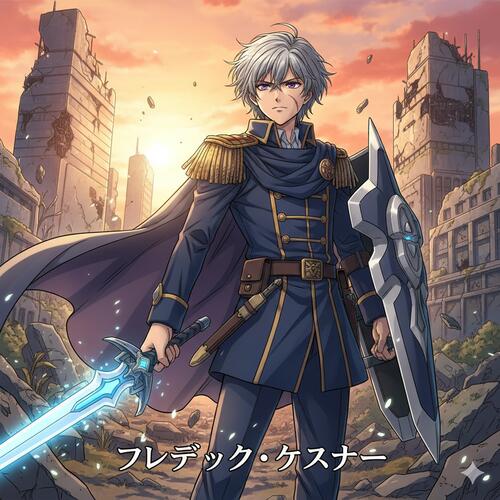
He faced the void like a cartoon hero,
not with the easy cry of “Believe in yourself!”
but the harsher creed: “One must imagine Sisyphus happy.”
The moths bore his manifestos into flame,
while history yawned, shelving him beside
pamphlets on extinct animals.
And then—tree or tarmac, it mattered little—
the absurd he crowned crowned him in return:
not laurel, but twisted chrome and shattered glass.
The philosopher of chance was felled by chance,
his last ticket unused, his last line unfinished—
a coronation written in wreckage.
.
weapons of mass distraction
weapons of mass distraction
Screens glow like altars.
We kneel, thumbs twitching
prayers to gods of noise.
The loudest silence is
the one we scroll past.
Billboards bloom
like invasive flowers,
their petals of neon
masking the stars.
We are armed not with rifles,
but with endless feeds,
notifications detonating
in the pocket. The war is
not for land, but for attention.
Somewhere, a child waits for
a story that is not interrupted
by a ringtone.
The weapon is simple:
keep you from yourself.
.
fragment from the hill
"Fragment from the Hill"
I know the stone will fall.
I know the slope will not forgive.
Each ascent is already erased,
yet it is mine—
the weight, the sweat, the rhythm of refusal.
Do not pity me.
The gods gave me repetition,
but they could not touch my laughter.
In the pause, walking back down,
I taste the air sharper than any victory.
Happiness is not in the summit,
but in the push,
in the stubborn heartbeat that says:
I am here,
I am alive,
and I will shoulder this absurd crown again.
.
patchwork of living
In the mirror, a story is told,
Crow’s feet and creases, a map grown old.
Each line a journey, laughter and pain,
Life etched in furrows that still remain.
Spots like lanterns, memories bright,
Love and fierce dreams taking flight.
Time shapes the body, tender, profound—
A patchwork of living, art all around.
.